
Key Takeaways
- What it is: solo Mahjong Solitaire on a 144-tile board. No opponents, no turns, no scoring. You clear the board or you don't.
- The rule that decides everything: a tile is selectable only if nothing covers it and one long side, left or right, is open.
- The one exception: the 8 bonus tiles match loosely. Any Flower goes with any Flower, any Season with any Season.
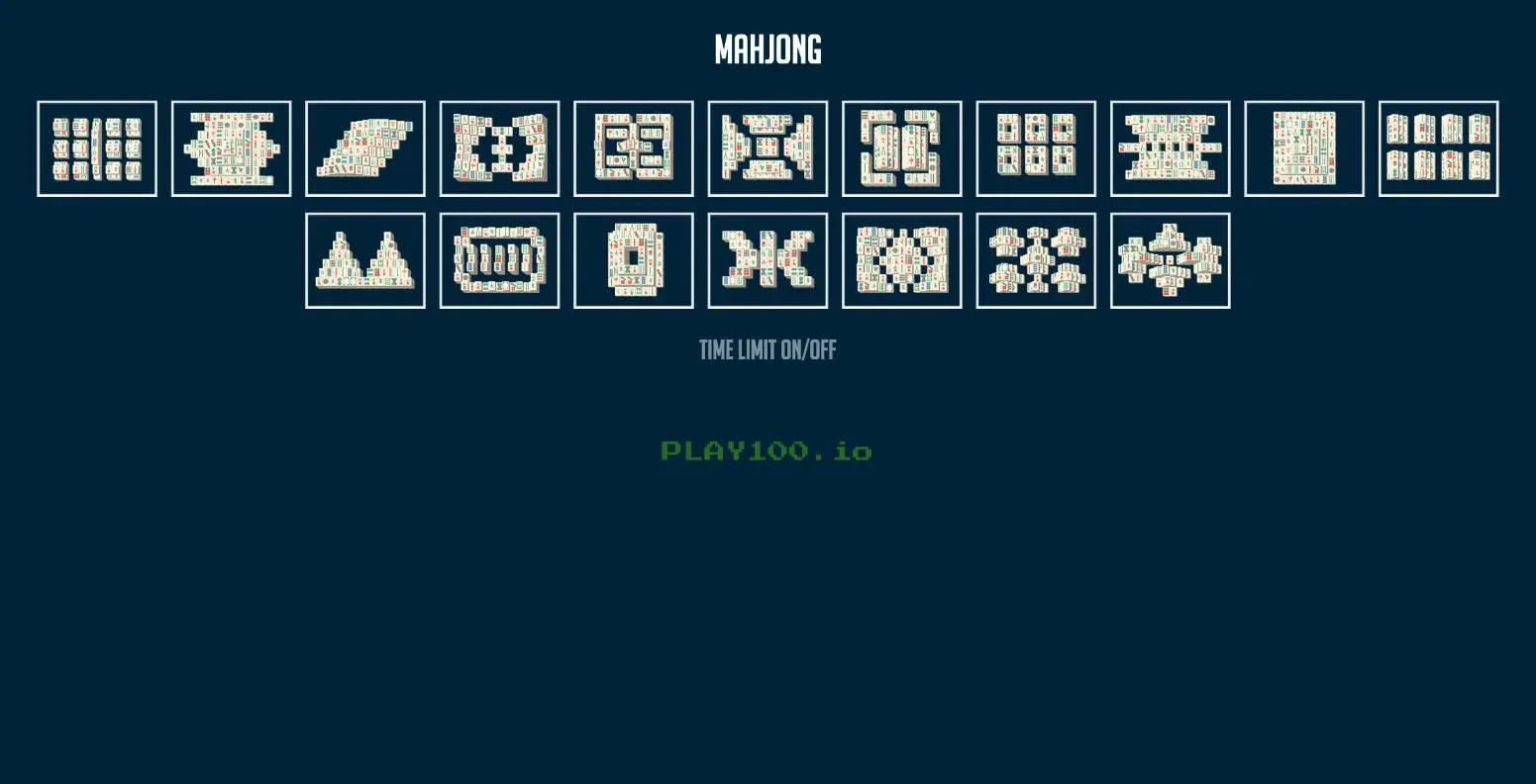
- The board: 18 layouts including the classic Turtle, plus a Time Limit ON/OFF toggle before the round starts.
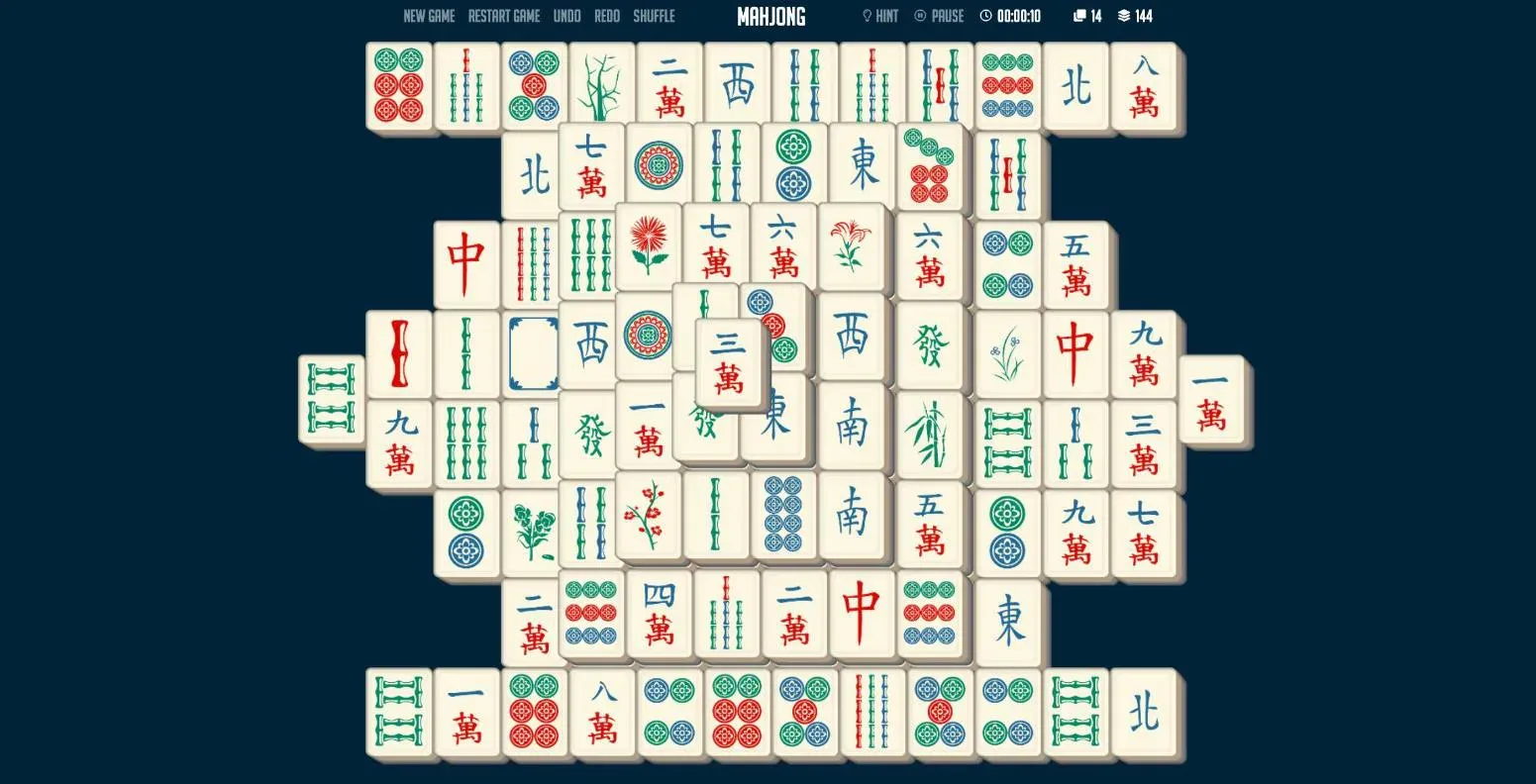
- The toolbar: 7 controls (New Game, Restart Game, Undo, Redo, Shuffle, Hint, Pause) plus a live timer, move counter, and tile counter starting at 144.
- What this page covers: the rules, controls, and opening strategy for the game above. Not four-player Mahjong scoring, and not buying physical tile sets.
How to Play Mahjong Solitaire
The board opens with all 144 tiles face-up, stacked in layers so upper tiles block the ones under them. Every tile carries a design from a standard Chinese Mahjong set: three number suits (Bamboo, Characters, Dots), honor tiles (Dragons and Winds), and bonus tiles (Flowers and Seasons). Nothing is hidden. The difficulty comes from which tiles are reachable, not from information you lack.
A standard set breaks down like this, which explains two of the game's quirks:
| Tile group | Tiles in the set | What's in it |
|---|---|---|
| Number suits | 108 | Bamboo, Characters, Dots, ranks 1 to 9, four copies of each |
| Honors | 28 | 4 Winds (16 tiles) and 3 Dragons (12 tiles), four copies of each |
| Bonus | 8 | 4 Flowers and 4 Seasons, every one of them unique |
| Total | 144 | 34 repeated designs plus 8 one-off tiles |
Source: Wikipedia, Mahjong tiles.
Because 34 designs appear four times each, most tiles have three possible partners rather than one. That is why the "clear all four at once" tip below works. It also explains the Flower and Season exception: those 8 tiles are each unique, so under strict matching they could never be removed.
Play runs like this. Click a free tile to highlight it, then click its partner to remove the pair. Removing a pair exposes whatever was underneath and unblocks whatever was beside it, and that chain reaction is the actual game. Keep going until the counter reads 0 to win. Running out of available pairs while tiles remain is the losing condition.
The Toolbar: Every Control You Have
The toolbar sits above the board and holds seven buttons, five on the left and two on the right next to the readouts.
- New Game starts a fresh round with a new arrangement.
- Restart Game resets the current round with the same arrangement, so you can try a different opening.
- Undo takes back your last removal and returns both tiles to the board.
- Redo replays a move you just undid.
- Shuffle rearranges the tiles still on the board. This is the deadlock escape.
- Hint points out one currently available pair.
- Pause freezes the round and the clock.
Three readouts run alongside them: a timer, a move counter, and a remaining-tile counter that starts at 144 and counts down as the board empties.
The 18 Layouts and the Time Limit Toggle
Before a round begins you land on a layout picker with 18 board arrangements. The classic Turtle pyramid, the shape most people picture, is one of the 18 rather than a separate mode. The others change the silhouette of the stack, and with it the ratio of reachable edge tiles to buried center tiles.
The same screen carries a Time Limit ON/OFF toggle. Off, the timer still runs but only as a record. On, the clock becomes a real constraint. Beginners learning the free-tile rule should keep it off; it is the setting that changes how the game feels most.
Tips and Strategy
Mahjong Solitaire looks like a spot-the-pair game and mostly is not. Almost every lost board was lost by removing the wrong pair early, not by missing a match.
- Work from the top layers and outer edges inward. Tiles high in the stack block the most tiles beneath them, so clearing them returns the most options per match.
- Check what a pair frees before you take it. A match that opens no new tile has spent one of your limited pairs for nothing. When two pairs are available and only one unblocks something, take that one.
- Scan for all four copies of a design. Since most designs exist four times, a free set of four clears the whole group in two moves. Leaving two stranded in separate corners is a classic way to deadlock a board.
- Treat Shuffle as a repair, not a plan. It rescues a dead board but scrambles the mental map you had built. Undo is the cheaper correction right after one bad move.
Mahjong Solitaire vs. Traditional Mahjong
These are two different games that share a tile set, which is the biggest source of confusion when people search for "mahjong."
| Mahjong Solitaire (this game) | Traditional Mahjong | |
|---|---|---|
| Players | 1 | 4 |
| Tiles used | All 144, face-up in a stack | 144, drawn from face-down walls |
| Core action | Remove matching pairs of free tiles | Draw and discard to build a winning hand |
| Turns | None. You move whenever you like | Strict turn order |
| Scoring | None. Clear the board or don't | Hand values, points, and settlements between players |
| Round ends when | The board is empty or no pair is free | A player completes a legal hand |
Traditional Mahjong developed in 19th-century China, where four players draw and discard tiles to assemble a scoring hand of melds (Wikipedia, Mahjong). The solitaire version is much younger and was born on a computer rather than a table: Brodie Lockard built the first digital Mahjong Solitaire on the PLATO system in 1981, and Activision's Shanghai carried it to a mass audience in 1986 (Wikipedia, Mahjong solitaire). If you learned Mahjong at a family table, almost nothing you know about turn order and scoring applies here.
Ready to Clear Your First Board
So, back to the question that brought most people here: is this the Mahjong you were looking for? If you wanted four players, discards, and a scored hand, no. If you wanted the puzzle where 144 tiles come down two at a time and the only opponent is your own move order, yes, and it is ready above.
Start with the Turtle layout and the Time Limit off, and save Hint for when you genuinely cannot find a pair. Once a full clear stops feeling lucky, switch the Time Limit on or try one of the other 17 layouts.